




Andrei Chibis spoke about a comprehensive project to develop the Arctic and the Third Transport Ring at a meeting of heads of Russian regions under the Russian Ministry of Foreign Affairs, chaired by Sergei Lavrov
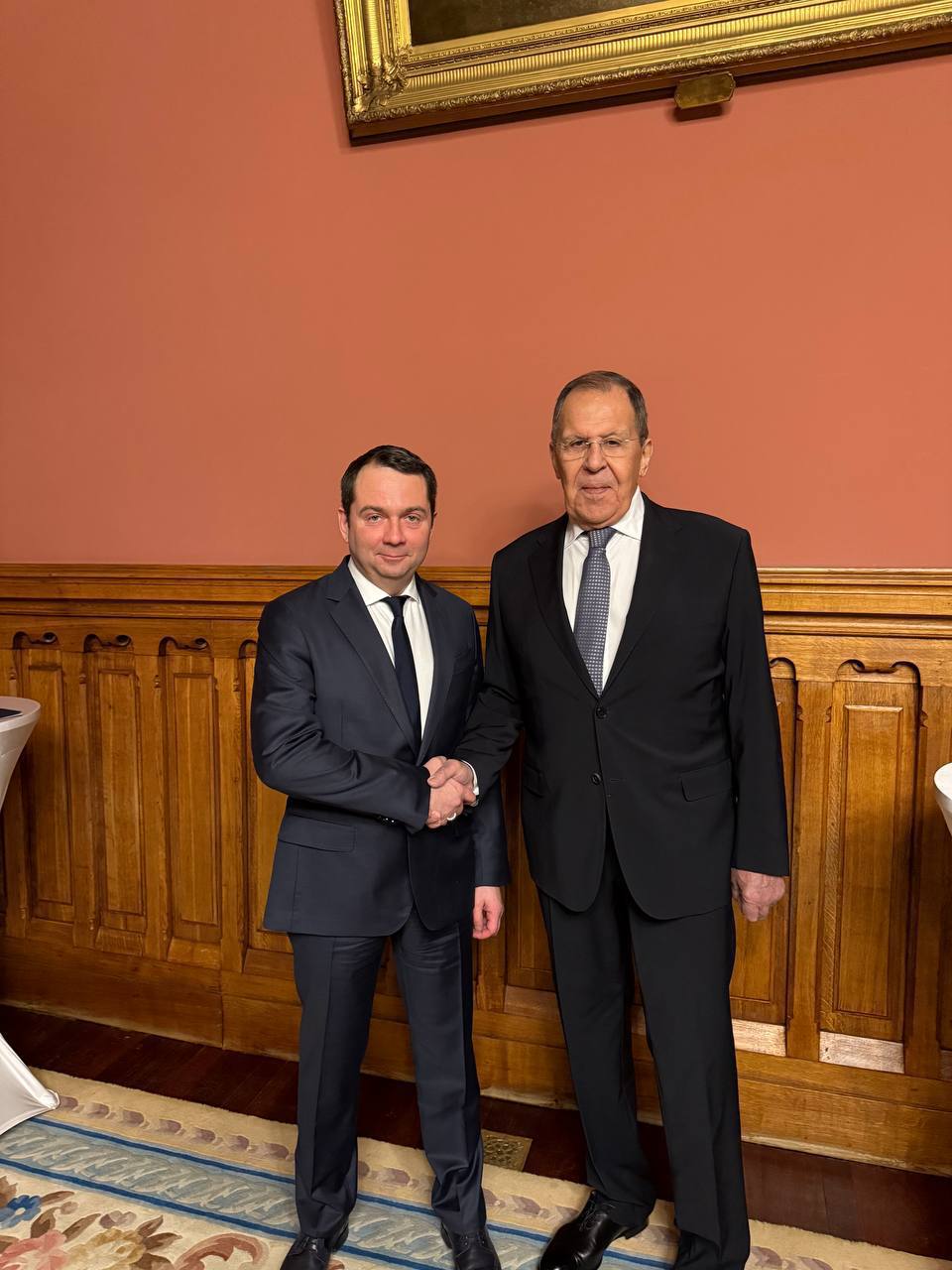
In Moscow, Russian Foreign Minister Sergey Lavrov held the 45th meeting of the heads of the constituent entities of the Russian Federation under the Russian Foreign Ministry. Murmansk Region Governor Andrei Chibis also participated. The meeting focused on the development of the Arctic, a strategically important macroregion for Russia.
"I have no doubt that our country's foreign policy in the Arctic will retain its multi-vector nature and pragmatic approach. We will continue to work purposefully to address the objectives set by the country's leadership. As Russian President Vladimir Vladimirovich Putin emphasized during his speech at the Eastern Economic Forum in September, extensive work is underway in the Far East and the Arctic, and we are open to all who are willing to participate. Naturally, participation should be based on equality, respect for Russian interests, and the principles that underlie interaction with foreign colleagues in the Russian Arctic," noted Sergey Lavrov.
In his report, Governor Andrei Chibis, Chairman of the State Council Commission on the Northern Sea Route and the Arctic, described the comprehensive Arctic and Trans-Arctic Transport Corridor development project.
"Let me remind you that it has already received the support of President Vladimir Vladimirovich Putin, and we are now actively working on its implementation," the governor noted.
The regional governor emphasized that Russia's Arctic territories occupy the largest area in the world, generating up to 10% of the country's GDP despite accounting for less than 2% of the population. The Russian Arctic boasts the world's only nuclear-powered icebreaker fleet and is home to a key resource base: approximately 80% of gas production and approximately 10% of oil production, 100% of Russia's nickel, rare earth metals, platinum group metals, and apatite ores are produced in the Arctic. The Arctic seas are a key element of the country's fisheries and food security. The Northern Sea Route, which forms the basis of the Trans-Arctic Transport Corridor, is of global significance: it is 40% shorter than the traditional route through the Suez Canal.
"Developing the Arctic today is like space exploration for the USSR. In recent years, thanks to the work of the Russian Government and the decisions of President Vladimir Vladimirovich Putin, we have undoubtedly achieved good results. These are enshrined in the Arctic Development Strategy approved by the head of state," the governor emphasized.
This includes attracting over 35 trillion rubles in investment, and implementing over a thousand projects. Cargo traffic along the Northern Sea Route has reached a historic high—up to 38 million tons in 2024. A northern delivery system has been established. Powerful support tools have been created—from a unified presidential subsidy to comprehensive master plans for the development of key communities. A renovation program for closed administrative-territorial entities (ZATOs) has been launched. Preferential mortgage rates at 2% have been extended to the Arctic zone.
"Many of these initiatives were put forward by our relevant State Council Commission and supported by the President and the Government. However, new conditions dictate the need to create a comprehensive project for the development of the Arctic and the Trans-Arctic Transport Corridor. We first raised this issue in 2024. Subsequently, we discussed this topic repeatedly within the Commission and the Maritime Board and secured support from the heads of federal agencies, experts, and the heads of Arctic regions. The President supported the initiative and, at the November meeting, gave specific instructions on developing a comprehensive project. Now it is crucial to consider all the objectives and parameters, as well as its management model," the Governor stated.
Andrei Chibis noted that developing the TTC requires creating all the necessary infrastructure, particularly to ensure the outward movement of cargo. The Murmansk Transport Hub plays a major role here. The goal is to create two powerful hubs: Murmansk in the west and Vladivostok in the east.
Among the projects with international participation that fit within the Third Transport Ring's development concept, the governor highlighted the creation of a multifunctional terminal in Murmansk for transshipment of Belarusian cargo, as well as active collaboration with Chinese partners on joint projects, including organizing regular container shipments through the port of Murmansk and developing port infrastructure to increase cargo flow.
The head of the Murmansk Region also shared initiatives regarding Spitsbergen, which he had previously announced at a meeting of the Government Commission chaired by Deputy Prime Minister Yuri Petrovich Trutnev: the creation of a base for servicing the Russian fishing fleet on the archipelago, as well as the establishment of a partnership between the Murmansk Aviation University and the new International Scientific and Educational Center on Spitsbergen.
"We will do everything possible to ensure that these projects open up new opportunities for the Murmansk Region and Russian projects on the Spitsbergen archipelago," commented Andrei Chibis.
/Ministry of Information Policy of the Murmansk Region/
 Investment portal of Murmansk region
 Investment map of Murmansk region
 Agency of Strategic Initiatives
 Мойбизнес.рф
  Development center of
  Murmansk city Administration
 Investment portal of Arctic zone
 Rosinfra