




EEF 2026: Murmansk Region as a Security Core Region for the Trans-Arctic Transport Corridor
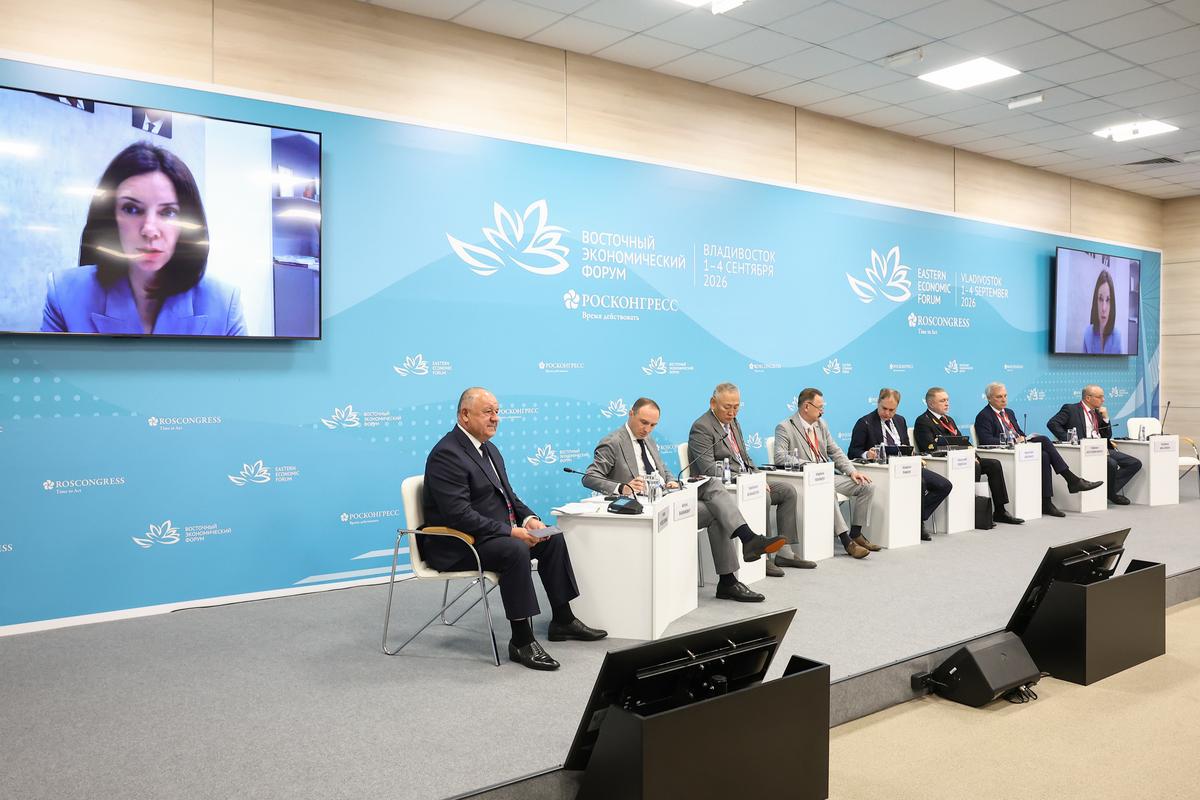
On September 2, at the Eastern Economic Forum, Svetlana Panfilova, Deputy Governor and Minister of Arctic Development and Economy of the Murmansk Region, participated in the key session "Comprehensive Solutions for Ensuring Security of the Northern Sea Route and the Third Transport Corridor." The event, part of the "Logistics and Infrastructure for Economic Growth" track, focused on enhancing national security in the Arctic zone and the Far East along the Northern Sea Route and the Trans-Arctic Transport Corridor. Viktor Yatsutsenko, Deputy Minister of the Russian Federation for Civil Defense, Emergencies, and Disaster Relief, moderated the session.
Participants discussed security measures for the territories, seas, and airspace along the Northern Sea Route and the Trans-Arctic Transport Corridor, as well as logistical solutions for enhancing security in the Arctic and the Far East.
The NSR and the emerging Third Transport Corridor route passes through areas with a harsh climate, limited infrastructure, and low population density, and some sections are border areas. This objectively increases the risk of emergency situations and requires a systematic approach to security.
In her speech, Svetlana Panfilova emphasized that the Murmansk Region, as the gateway to the Northern Sea Route, views security not as an incidental task, but as a system-forming one for all TTK logistics. It is important to consider the impact of security on the investment climate: an investor investing in a port or terminal for decades to come evaluates not only the project's economics but also the security of the territory. The social component is equally important: people decide to stay in the Arctic or leave based, among other things, on a sense of security.
The Murmansk Region's approach is based on systematic work initiated and supported at the federal level. Andrei Chibis, Chairman of the State Council Commission "Northern Sea Route and the Arctic" and Governor of the Murmansk Region, has consistently advocated for security to be built into the TTK's development logic at the planning stage, rather than being added onto existing projects. On his initiative, together with the Russian Ministry of Emergency Situations, it was proposed to include the section “Ensuring Comprehensive Security” in comprehensive plans for the long-term socio-economic development of key settlements in the Arctic zone, and measures to develop emergency rescue infrastructure in a comprehensive project for the development of the Arctic zone and the Trans-Arctic Transport Corridor.
One of the Murmansk Region's key initiatives was the inclusion of an Arctic section in the United Russia People's Program, which included proposals for the construction of nuclear-powered icebreakers and rescue vessels, the development of a permafrost monitoring system, the development of standards for the construction and operation of facilities in northern conditions, and other areas. The document is aligned with the comprehensive Arctic and Third Transport Ring development project and the Arctic development strategy through 2050, which will be presented to the President.
A number of initiatives have already been implemented. Following Chibis's request regarding excessive standards, the Russian Ministry of Transport adjusted the requirements for equipping bridges in the Arctic zone with backup power supply and internet. Compliance with these standards, given that 100% of bridges lacked a stable signal and 75% were not connected to the power grid, would have cost billions of rubles. The removal of these excessive requirements did not impact the safety of the facilities, and the savings will be used for socially significant projects.
The Murmansk Region is actively participating in practical safety exercises. Since 2021, the region has been participating in the "Safe Arctic" exercise; in 2023, the Murmansk Region hosted the exercise. The Arctic Integrated Emergency and Rescue Center of the Russian Ministry of Emergency Situations (EMERCOM) and its branches operate in Murmansk, and since 2023, an air rescue unit has been on duty, covering a section of the NSR.
"Security infrastructure is not an auxiliary element, but an integral part of the Trans-Arctic Corridor, just like ports, the fleet, and rail approaches. The growth of cargo traffic along the NSR, the expansion of the Murmansk transport hub, and the arrival of new lines and partners are placing increasing strain on the response system, and this strain must be provided with resources in advance, not after incidents," noted Svetlana Panfilova.
According to Russian Deputy Minister of Transport Alexander Poshivay, the Russian Ministry of Transport, together with Rosatom and the Ministry of Emergency Situations, are working on expanding the Arctic rescue fleet. Five ice-class rescue vessels were commissioned in 2025–2026, and five more tugboats will be commissioned by the end of 2027.
/Ministry of Arctic Development and Economy of the Murmansk Region/
Photo: Roscongress
 Investment portal of Murmansk region
 Investment map of Murmansk region
 Agency of Strategic Initiatives
 Мойбизнес.рф
  Development center of
  Murmansk city Administration
 Investment portal of Arctic zone
 Rosinfra